
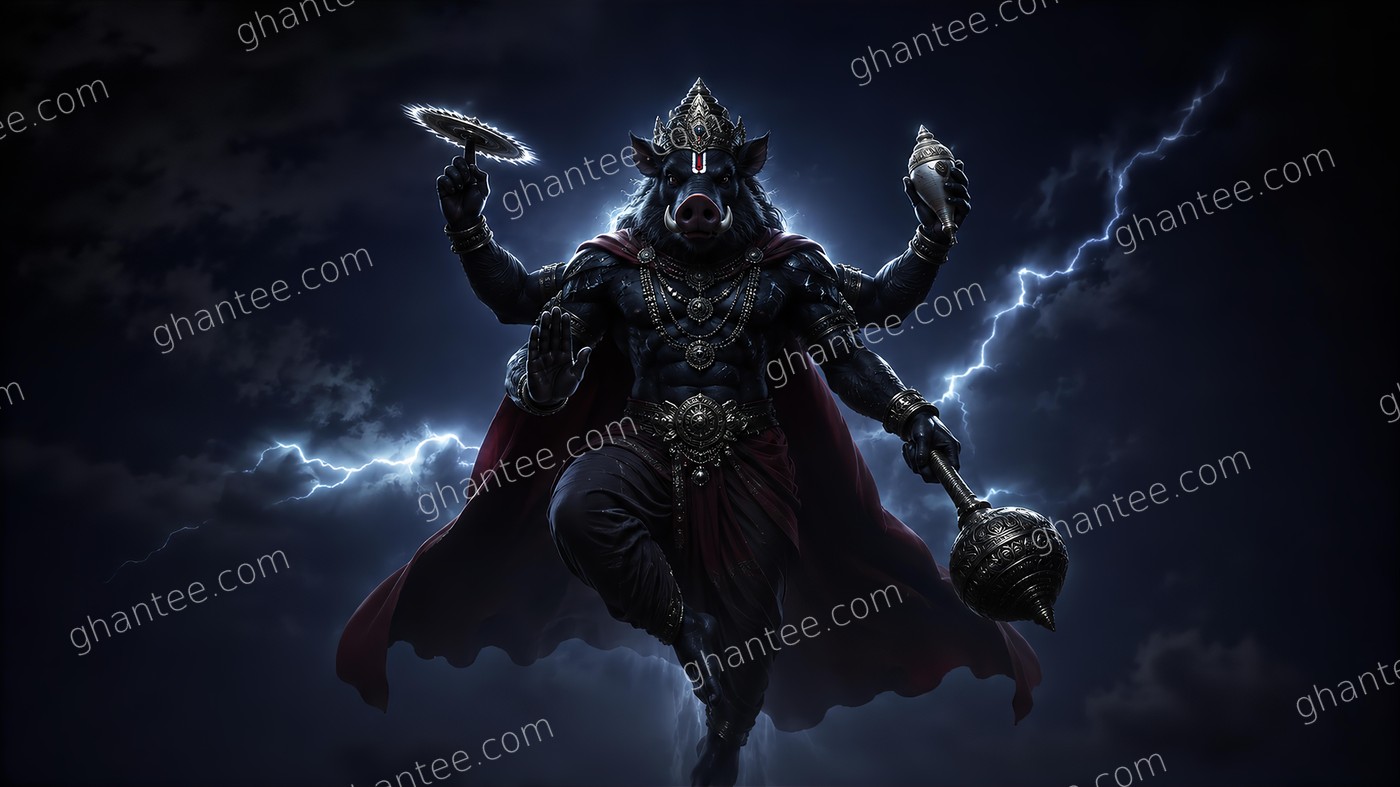
Varaha is the third avatar of Lord Vishnu in the Dashavatara — the divine boar who plunged into the cosmic ocean to rescue the Earth (Bhudevi) after the demon Hiranyaksha dragged her to the depths of the primordial waters. Where Matsya preserved the Vedas from dissolution, Varaha’s task was even more fundamental: to physically lift the Earth itself back into place, restoring the ground on which all life stands.
Varaha is depicted with a boar’s head and a human body, immense in scale, raising the Earth — often shown as the goddess Bhudevi — on the tip of a single tusk, a battle against Hiranyaksha lasting a thousand years before the demon was finally slain.
In this post, you’ll find:
Jayadeva’s classical Sanskrit verse on the Varaha avatar (from the Dashavatara Stotra)
Its meaning in English
The story of Hiranyaksha and the rescue of the Earth
Why Varaha’s form carries such deep symbolic weight
🔱 Varaha Avatar Verse (Jayadeva’s Dashavatara Stotra)
वसति दशनशिखरे धरणी तव लग्ना
शशिनि कलङ्ककलेव निमग्ना
केशव धृतसूकररूप जय जगदीश हरे ॥
🧘♂️ Meaning (Simple & Clear)
वसति दशनशिखरे धरणी तव लग्ना
The Earth rests, held fast, upon the tip of your tusk.
The entire weight of the world balanced upon a single point — Jayadeva’s image is deliberately impossible by ordinary physics, and that is the point: only divine power can hold what mortal strength cannot.
शशिनि कलङ्ककलेव निमग्ना
Like the dark mark sunk into the disc of the moon.
Jayadeva reaches for the most familiar image of something small resting steadily within something vast — the way the moon’s shadow-mark sits calmly on its bright surface — to describe how naturally the Earth rests upon Varaha’s tusk, without strain, without danger of falling.
केशव धृतसूकररूप जय जगदीश हरे
O Keshava, who takes the form of the boar — victory to you, Lord of the universe, Hari!
The same refrain that closes every verse of the Dashavatara Stotra, honoring the one Lord across every form he takes.
🔥 Deeper Spiritual Meaning
Varaha’s story begins with Hiranyaksha, a demon who had grown so powerful that he dragged the Earth itself to the bottom of the cosmic ocean — a myth that reads, at its core, as a warning about what happens when unchecked greed and arrogance are allowed to take hold unopposed: the very ground beneath everyone’s feet becomes unstable.
The boar form → Raw, primal strength suited to a task no refined or delicate form could accomplish
The single tusk → Focused, undivided power directed at exactly one purpose
Bhudevi lifted from the depths → Restoration of stability and dharma after they have been dragged to their lowest point
A thousand-year battle → Persistence — some rescues are not instantaneous, and divine grace does not mean effortless victory
The Earth compared to the moon’s mark → Even the largest burden becomes light and steady once held by the right power
Hiranyaksha’s defeat → Unchecked greed and arrogance are never permanently victorious, however dominant they appear
Varaha is one of the most physically dramatic of all the avatars — there is no diplomacy in this story, no negotiation. When the ground itself is at stake, the response has to match the scale of the threat. That is Varaha’s particular teaching among the ten: some crises call for raw, immovable strength, applied without hesitation.
✨ The Power of Varaha
Varaha teaches that when the very foundation something rests on is threatened, half-measures are not enough — the response has to be total.
The tusk represents focused strength aimed at a single, essential task. The thousand-year battle represents the willingness to see a rescue through to the end, however long it takes. And the Earth resting calmly once restored represents the deep peace that follows, once the ground beneath everyone’s feet is stable again.
That is the deeper lesson of Varaha: the foundation always deserves to be protected first — nothing else can stand without it.
✨ Final Thought
Meditate upon Varaha as the immense boar-formed Lord, rising from the depths of the cosmic ocean with the Earth balanced steadily upon his tusk, having faced a thousand-year battle to bring her home.
See the sheer power of this form, but see also its purpose — not conquest, but restoration; not domination, but the simple, essential act of putting the ground back beneath everyone’s feet.
May the remembrance of Varaha restore stability wherever it has been lost, and grant the strength to protect what everything else depends upon.


Add comment