
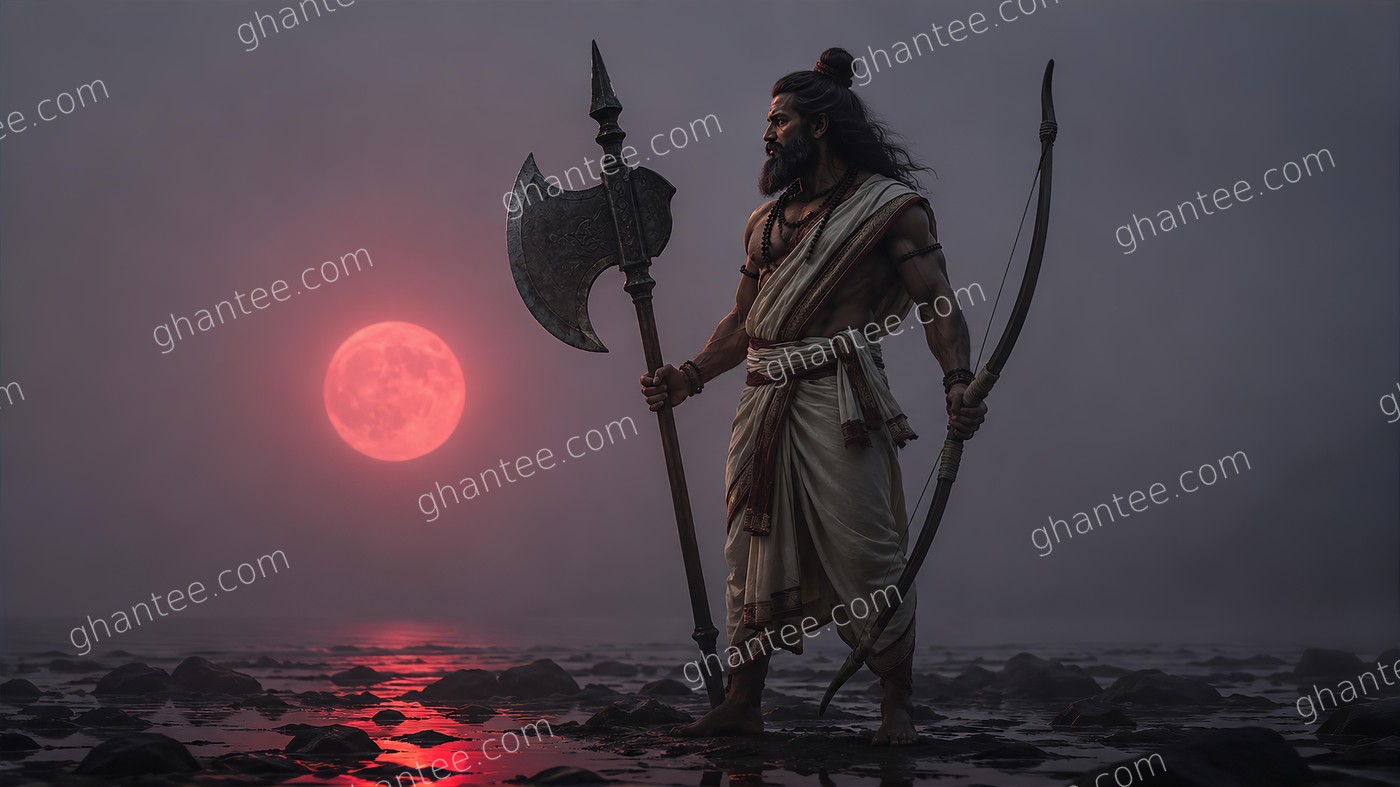
Parashurama is the sixth avatar of Lord Vishnu in the Dashavatara — the axe-wielding Brahmin-warrior who appeared to correct a world where kings had grown so corrupt and tyrannical that dharma itself was collapsing. Unique among the avatars, Parashurama is said to still be alive today, a Chiranjivi (immortal being) residing in penance, and unique again in that he shares the Earth’s timeline with later avatars like Rama and Krishna.
Born a Brahmin but trained as a fierce warrior by Lord Shiva himself, Parashurama took up his axe after King Kartavirya Arjuna’s sons murdered his father, Sage Jamadagni — but his campaign grew into something far larger than personal vengeance: a systematic correction of a warrior class (Kshatriyas) that had abandoned its duty to protect and had instead turned to oppression.
In this post, you’ll find:
Jayadeva’s classical Sanskrit verse on the Parashurama avatar (from the Dashavatara Stotra)
Its meaning in English
The story of Jamadagni’s death and Parashurama’s campaign against tyranny
What this fierce avatar teaches about correcting power that has forgotten its purpose
🔱 Parashurama Avatar Verse (Jayadeva’s Dashavatara Stotra)
क्षत्रियरुधिरमये जगदपगतपापं
स्नपयसि पयसि शमितभवतापम्
केशव धृतभृगुपतिरूप जय जगदीश हरे ॥
🧘♂️ Meaning (Simple & Clear)
क्षत्रियरुधिरमये जगदपगतपापं
In waters made of Kshatriya blood, you cleanse the world of sin.
The image is deliberately severe — Jayadeva does not soften what Parashurama’s campaign involved. The verse presents it plainly as a necessary cleansing, not a celebration of violence for its own sake.
स्नपयसि पयसि शमितभवतापम्
You bathe the world in these waters, calming the fever of worldly existence.
The word shamita, “calmed” or “extinguished,” reframes the entire act — what looks like violence at the surface is, in the verse’s own telling, a fever-reducing remedy for a world that had grown sick with tyranny.
केशव धृतभृगुपतिरूप जय जगदीश हरे
O Keshava, who takes the form of the lord of the Bhrigus — victory to you, Lord of the universe, Hari!
The refrain shared across every verse of the Dashavatara Stotra. Bhrigu was the great sage from whose lineage Parashurama descended.
🔥 Deeper Spiritual Meaning
Parashurama’s story confronts a difficult but essential idea: power that has forgotten its purpose becomes the very thing dharma has to correct. The Kshatriya class existed to protect the world — when it turned instead to oppressing it, the correction needed to be as forceful as the abuse of power had become.
The axe (parashu) → A tool of decisive, unambiguous correction, gifted directly by Lord Shiva
A Brahmin trained as a warrior → Wisdom and force united in one avatar, rather than kept apart
Jamadagni’s murder as the trigger → Even the most sweeping correction of a corrupt system can begin from a single, personal injustice
Twenty-one campaigns against tyranny (per tradition) → Lasting change sometimes requires sustained, repeated effort, not a single decisive act
Immortality (Chiranjivi status) → The vigilance dharma requires against the abuse of power is never truly finished
The “fever” of worldly existence, calmed → Even the fiercest correction is ultimately in service of peace, not conflict for its own sake
Parashurama’s ferocity is not celebrated for its own sake in this tradition — it is understood as the necessary response to a specific failure: power that stopped protecting and started oppressing. It is one of the clearest teachings in the Dashavatara that dharma sometimes requires force, precisely because unchecked power rarely corrects itself.
✨ The Power of Parashurama
Parashurama teaches that when those entrusted with power turn it against the very people they were meant to protect, correction cannot wait for gentler measures alone.
The axe represents decisive, unambiguous action against injustice. The repeated campaigns represent the patience required to see real correction through to completion. And the “calming of the world’s fever” represents the ultimate purpose behind even the fiercest of the ten avatars: not destruction for its own sake, but the restoration of a world capable of peace again.
✨ Final Thought
Meditate upon Parashurama as the Brahmin-warrior, axe in hand, who rose to correct a world where power had forgotten its duty to protect — fierce in his action, but always in service of restoring the balance that tyranny had broken.
May the remembrance of Parashurama grant the courage to correct injustice where it has taken root, and the wisdom to know that true strength serves protection, not domination.




Add comment