
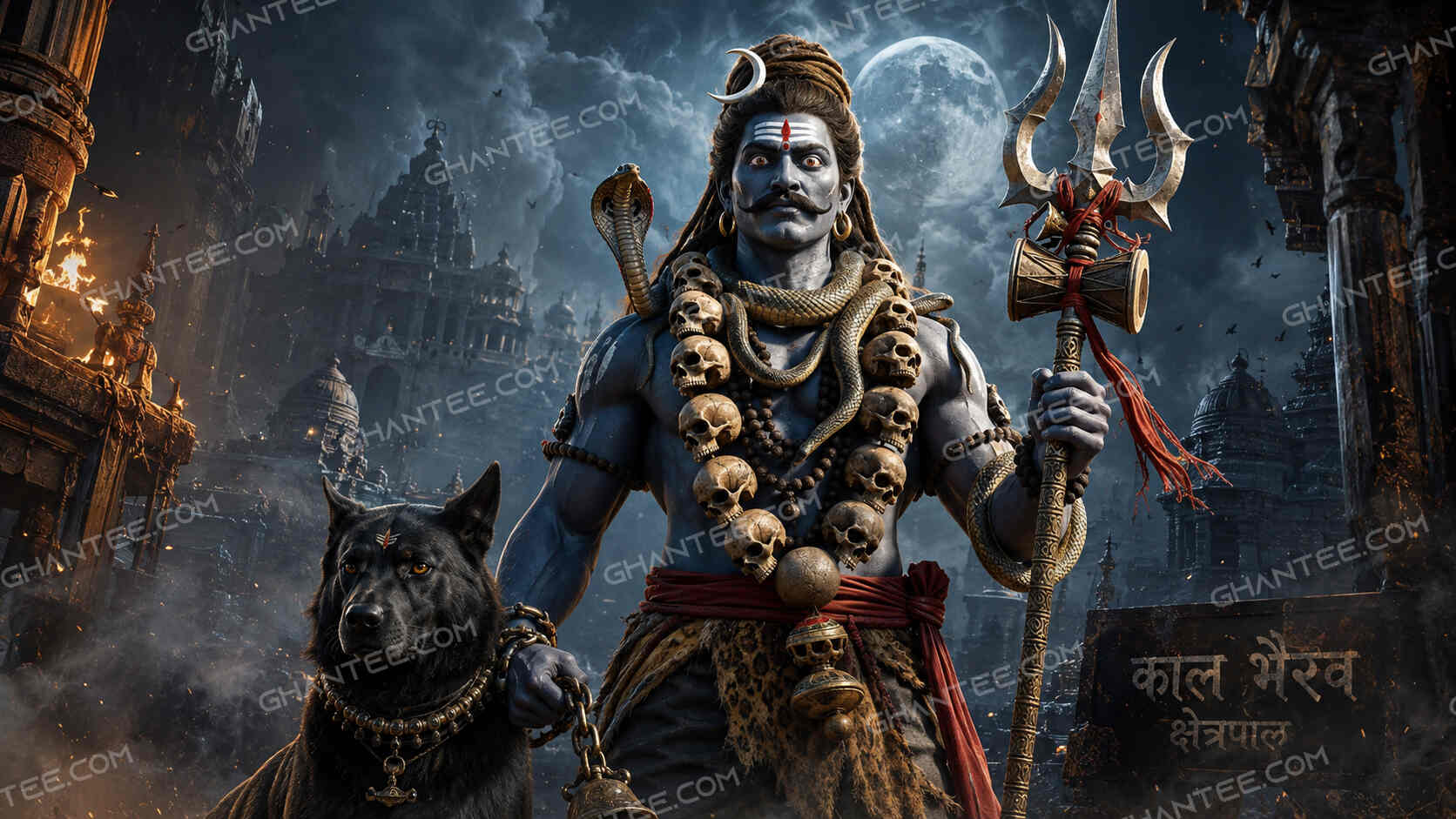
The Kaal Bhairav Dhyanam is a Sanskrit meditation verse dedicated to Shri Kaal Bhairava, the fiercest and most revered of the Ashta Bhairavas — the eight guardian forms of Lord Shiva. Kaal Bhairava is worshipped as the Kotwal (guardian) of Kashi, the deity who governs time itself (Kaal), and the one who protects devotees from untimely death, fear, and negative forces.
The verse presents Kaal Bhairava in his most awe-inspiring form — dark-complexioned, garlanded with skulls, accompanied by his vahana the dog (shvana), and holding weapons that represent his absolute authority over time, death, and dharma. This imagery makes Kaal Bhairava one of the most powerful and protective deities in Shaiva tradition, worshipped especially in Kashi (Varanasi) where he is believed to be the city’s chief guardian, with Lord Shiva himself having appointed him to this role.
In this post, you’ll find:
The Sanskrit Kaal Bhairav Dhyanam
The line-by-line meaning in English
The deeper spiritual symbolism of his form
The significance of his weapons, his dog, and his role as guardian of Kashi
🔱 Kaal Bhairav Dhyan Mantra
ॐ भैरवाय नमस्तुभ्यं
कालरूपाय ते नमः
दिगम्बर नमस्तुभ्यं
शवरूढाय ते नमः
त्रिनेत्राय नमस्तुभ्यं
व्याघ्रचर्मधराय च
खट्वाङ्गशूलहस्ताय
शवरूढाय ते नमः
श्वानारूढं दिगम्बरं दण्डपाणिं
वन्दे कालभैरवं क्षेत्रपालम्
इति श्रीकालभैरवध्यानम् ॥
🧘♂️ Line-by-Line Meaning (Simple & Clear)
Verse 1
ॐ भैरवाय नमस्तुभ्यं
Salutations to Lord Bhairava.
The meditation opens with a direct bow to Bhairava, the fierce protective form of Shiva. This first line establishes reverence and surrender before contemplating his terrifying yet compassionate form.
कालरूपाय ते नमः
Salutations to you, the form of Kaal (Time).
Kaal Bhairava is Time itself personified — the force that governs birth, decay, and death for all beings. To bow to him is to acknowledge the power that rules over every moment of existence, and to seek protection from its harshest edge, untimely death.
Verse 2
दिगम्बर नमस्तुभ्यं
Salutations to you, the sky-clad one.
Digambara, “clothed in the directions,” signifies complete freedom from worldly limitation — a form so vast and unbound that the four directions themselves are his only garment.
शवरूढाय ते नमः
Salutations to you, who is seated upon a corpse (shava).
This striking image represents Bhairava’s mastery over death itself — he does not fear it, he sits upon it. It is a reminder that the fiercest divine power exists beyond the cycle of birth and death that governs ordinary beings.
Verse 3
त्रिनेत्राय नमस्तुभ्यं
Salutations to the three-eyed one.
The third eye represents awakened, all-seeing divine vision — the ability to perceive past, present, and future, and to burn away ignorance in an instant.
व्याघ्रचर्मधराय च
And to the one who wears the tiger skin.
The tiger skin represents mastery over the fiercest, most untamed forces of nature — worn not as a trophy, but as a sign that even the wildest energies bow before Bhairava’s discipline.
Verse 4
खट्वाङ्गशूलहस्ताय
To the one who holds the khatvanga (skull-staff) and the trishul (trident) in hand.
The khatvanga represents victory over death and the ego, while the trishul represents control over the three gunas — sattva, rajas, and tamas — and the destruction of the threefold suffering that binds ordinary beings.
शवरूढाय ते नमः
Salutations again to the one seated upon the corpse.
The repetition reinforces this central image of the dhyanam — a reminder to the devotee that Kaal Bhairava’s authority over time and death is the very source of his power to protect.
Verse 5
श्वानारूढं दिगम्बरं दण्डपाणिं
Mounted upon a dog, sky-clad, holding the staff of justice.
The dog (shvana) is Kaal Bhairava’s vahana — a symbol of absolute loyalty, vigilance, and the ability to guard even the most hidden thresholds. The staff (danda) represents his authority to enforce dharma and deliver justice without exception, to king and commoner alike.
वन्दे कालभैरवं क्षेत्रपालम्
I bow to Kaal Bhairava, the guardian of the land (Kshetrapal).
The meditation closes by naming his most important role — Kshetrapal, the protector of sacred ground. In Kashi, this is not a metaphor: Kaal Bhairava is worshipped as the literal gatekeeper of the city, and tradition holds that no pilgrimage to Kashi is complete without first seeking his permission.
🔥 Deeper Spiritual Meaning
Kaal Bhairava’s imagery carries a teaching that runs through all of Bhairava worship — true protection requires mastery over fear itself, and fear’s ultimate root is death. By meditating on a form that is seated calmly upon death, wielding time as his own instrument rather than being ruled by it, the devotee learns to face life’s uncertainties without being consumed by them.
Dark, formless complexion → The vastness of time and the unknown, held without fear
Three eyes → Awakened vision beyond past, present, and future
Digambara (sky-clad) → Freedom from worldly limitation and attachment
Seated upon a corpse → Mastery over death, not subjugation to it
Tiger skin → Discipline over the wildest, most untamed forces
Khatvanga (skull-staff) → Victory over the ego and the fear of death
Trishul (trident) → Control over the three gunas and the threefold suffering
Danda (staff) → Absolute, impartial justice and enforcement of dharma
Shvana (dog) → Loyalty, vigilance, and guardianship of every threshold
Role as Kshetrapal → Protector of sacred ground and of every sincere devotee who seeks refuge
Kaal Bhairava is often approached first among the Ashta Bhairavas because he is considered the gatekeeper — the one whose permission opens the door to the other forms of Shiva’s grace. His ferocity is not directed at the devotee, but at whatever stands between the devotee and liberation: fear, obstacles, enemies, and the anxiety of time running out.
✨ The Power of Kaal Bhairava
Kaal Bhairava teaches that the deepest fear — the fear of death and of time itself — can be faced directly, and even mastered.
The khatvanga represents victory over the ego. The trishul represents the power to cut through the threefold suffering of mind, body, and circumstance. The staff represents impartial justice that spares no one, and protects everyone who is righteous. The dog represents a vigilance that never sleeps. And at the center of it all sits a Lord who is not afraid of death, because he governs it.
That is the deeper lesson of Kaal Bhairava: the one who masters time and fear becomes the truest protector.
✨ Final Thought
Meditate upon Shri Kaal Bhairava as the dark, three-eyed Lord, sky-clad, seated upon Time itself, mounted on his loyal dog, holding the staff of impartial justice and the weapons that cut through fear.
See the ferocity of his form, but also see the vigilant guardian within it — the one who stands watch at every threshold so that dharma is never left undefended.
He rules over time without being ruled by it. He guards Kashi without ever resting. He is feared by those who mean harm, and he is refuge for those who surrender to him with a sincere heart.
May the meditation on Shri Kaal Bhairava remove fear of the unknown, protect against untimely obstacles, and grant the courage to face time itself with a steady mind.






Add comment