
As an Amazon Associate, House of Ghantee earns from qualifying purchases.
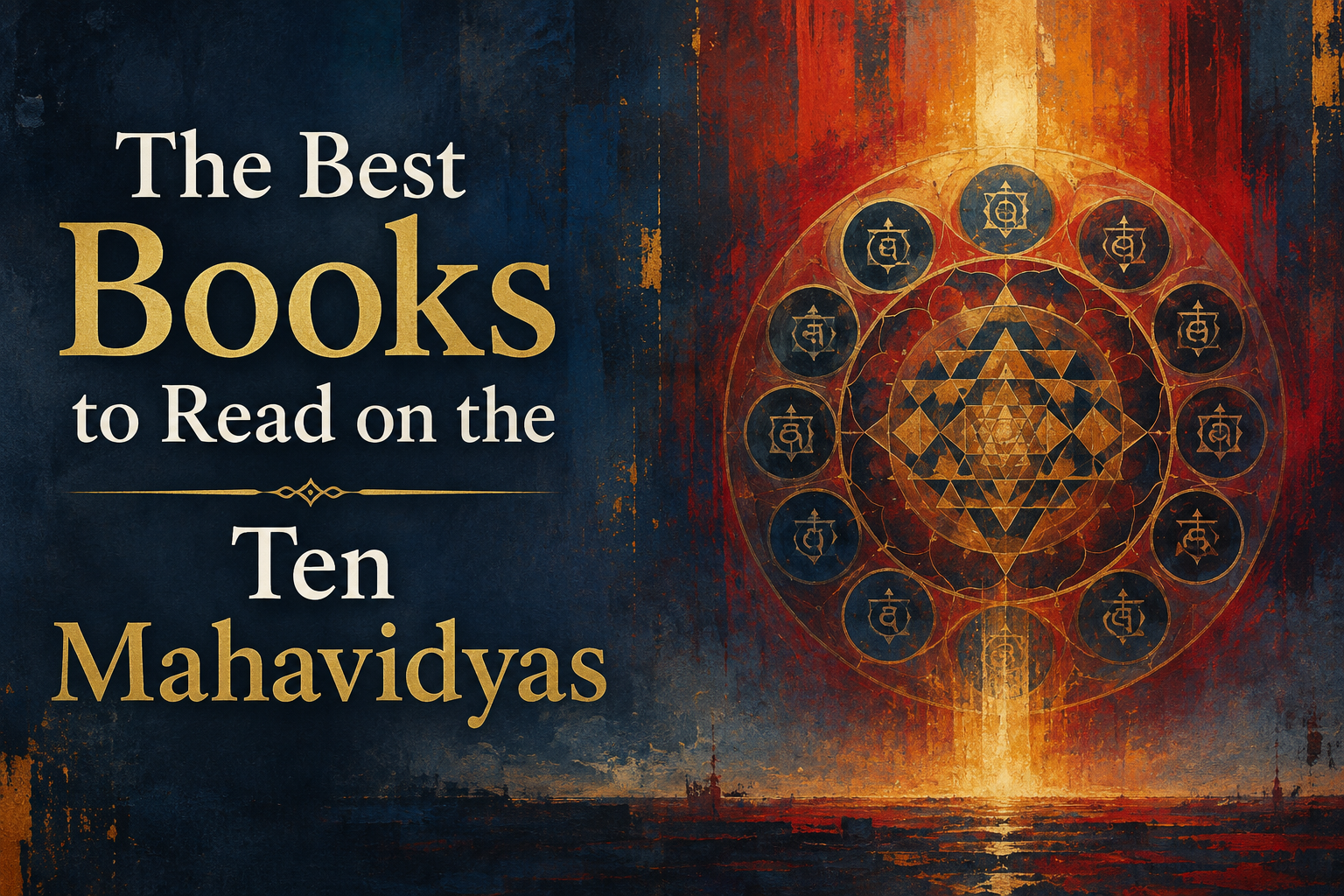
The ten Mahavidyas — Kali, Tara, Tripura Sundari, Bhuvaneshwari, Chinnamasta, Bhairavi, Dhumavati, Bagalamukhi, Matangi, and Kamala — are among the most profound and least understood forms of the Divine Feminine in Tantric tradition. Reading about them properly, rather than piecing together fragments from social media captions, changes how you understand every Dhyanam, mantra, and image on this site.
Below is a working reading list, organized by where you should actually start. We’ve split it into approachable entry points, scriptural translations, and deeper academic scholarship — because these are not interchangeable, and starting in the wrong place is the fastest way to get discouraged.
Availability, editions, and pricing shift on Amazon regularly, so we’d recommend confirming current print status before ordering rather than relying purely on this list being current forever.
Start Here: Accessible Introductions
Ten Great Cosmic Powers (Dasa Mahavidya) — S Shankaranarayanan
Written by S. Shankaranarayanan, a scholar in the Sri Aurobindo Ashram tradition, this remains one of the most respected focused treatments of the ten Mahavidyas specifically — not a broad survey of Devi worship, but a book built entirely around this one framework. Its tone sits between devotional and scholarly, aimed at a reader who wants to understand why these forms are worshipped and how they fit together as a system, not just what each one looks like. If you’ve read our Dhyanam posts and want a single next step, this is it.
7 Secrets of the Goddess — Devdutt Pattanaik
Pattanaik’s broader work on Devi across Indian mythology touches on several Mahavidya themes in an accessible, story-driven style. It’s not Mahavidya-specific the way Shankaranarayanan’s book is, but it’s a genuinely good on-ramp if the ten Mahavidyas as a group still feel unfamiliar, situating them within the wider tradition of goddess worship in India.
Going to the Source: Scripture and Primary Translation
Devi Mahatmyam: The Glory of the Goddess
Not a Mahavidya text specifically, but the foundational scripture establishing Devi as supreme Shakti — the theological ground the entire Mahavidya tradition builds on. If you’ve only ever read summaries of the Devi Mahatmya, reading an actual translation reframes a great deal of what gets casually referenced elsewhere.
Shakti and Shakta — Arthur Avalon (Sir John Woodroffe)
One of the foundational English-language works on Tantra as a coherent philosophical system, written by the British judge and scholar who did more than perhaps anyone to make serious Tantric philosophy legible to English readers. It’s older, denser prose, but it remains a genuine primary reference rather than a modern paraphrase — useful once you want to understand the philosophy behind Shakta worship, not only the iconography.
For Serious Study: Academic Scholarship
Tantric Visions of the Divine Feminine: The Ten Mahavidyas — David Kinsley
This is, without much competition, the single most cited English-language scholarly study of the ten Mahavidyas as a complete group. Kinsley, a religious studies scholar, treats each Mahavidya individually — her iconography, her textual sources, her place within Tantric philosophy — with the kind of rigor that devotional summaries (including, admittedly, some of what circulates online) tend to flatten out. If you read one book from this entire list, and you want to actually understand the Mahavidyas rather than just recognize their images, this is the one.
For the Visually Inclined: Art and Iconography
Kali: The Feminine Force — Ajit Mookerjee
Mookerjee’s work on Tantric art remains a standard reference for anyone trying to understand how Tantric iconography actually developed — the visual grammar behind attributes, colours, and postures that we draw on constantly when building the wallpapers and reference material on this site. This particular volume centers on Kali specifically, but the visual-symbolic approach carries over to how you’ll read every other Mahavidya’s iconography afterward.
How to Actually Use This List
If you’re new to the Mahavidyas: start with Shankaranarayanan’s Ten Great Cosmic Powers, then read our Dhyanam guides for each individual form as you go — the two complement each other well, one giving you the framework, the other giving you form-specific detail with dhyana mantras you won’t find translated elsewhere.
If you already know the basics and want depth: go straight to Kinsley. It’s the book most of our own iconographic research is checked against.
If you’re drawn to the visual/artistic side specifically: Mookerjee’s work pairs naturally with browsing our own Mahavidya wallpaper collection — seeing the iconographic principles explained alongside the actual forms makes both make more sense.
Every purchase made through the links above supports House of Ghantee at no extra cost to you — thank you for helping us keep researching and creating scripturally grounded content.







Add comment