
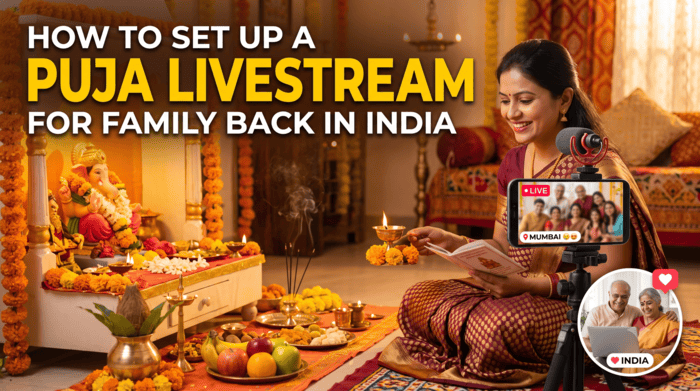
Your grandmother back in India wants to “be there” for the griha pravesh, the baby’s naming ceremony, or Diwali puja happening in your living room 8,000 miles away. A shaky phone call propped against a lamp doesn’t really cut it — and doesn’t have to. Here’s how to actually set up a livestream that makes people feel present, not just informed.
Pick the Right Platform for Who’s Watching
The best platform depends less on features and more on who’s on the other end. If it’s a handful of close family, a simple WhatsApp video call or Google Meet link works fine and needs zero setup for elderly relatives who may not want to download a new app. If you’re including a wider circle — extended family, family friends — a scheduled Zoom link or a private, unlisted YouTube livestream is more reliable for larger groups, and a YouTube stream can be recorded automatically so anyone who misses it live can watch later.
The Setup That Actually Matters
- Position the camera at the altar’s eye level, not from above looking down. A phone propped at the same height as the puja thali makes viewers feel like they’re kneeling beside it, not watching from a balcony.
- Use a second device as a dedicated camera, separate from whatever you’re using to actually talk to people. An old phone or tablet on a small tripod (or propped against a stack of books) pointed steadily at the altar works better than one device trying to do both jobs.
- Audio matters more than video quality. Mantras and aarti need to be heard clearly — place the device closer to where the priest or family member is chanting than you think you need to, since phone microphones pick up room echo badly at a distance.
- Add one extra light near the altar if the room is dim. Diya and candle light look beautiful in person but often reads as a dark, grainy blur on camera — a simple warm-white lamp just out of frame fixes this without ruining the ambience.
Making It Feel Like Presence, Not Broadcast
The technical setup is the easy part. What actually makes a livestream feel meaningful is including people in the ritual itself, not just letting them watch it happen:
- Ask an elder on the call to say a blessing out loud at the right moment — during the aarti, or right before the main ritual act — so their voice becomes part of the ceremony, not just commentary on it.
- If someone on the call was going to bring or bless a specific item in person (like tying a rakhi, or applying tilak), have a family member on your end act as their hands — narrate it as “Dadi, I’m doing this on your behalf now” so the gesture is acknowledged, not just skipped.
- Send a small piece of prasad by mail or courier afterward if the ceremony is significant enough (a wedding, a naming ceremony) — it closes the loop in a way video alone can’t.
Timing Across Time Zones
Many pujas have an auspicious muhurat (specific time window) that doesn’t bend to convenience — a 6 AM ceremony in the US might mean it’s late evening in India, which is fine for family, but can be genuinely difficult for elderly relatives who go to bed early. If the muhurat is flexible (as it is for many home pujas, though not for things like weddings), consider scheduling the livestream-friendly version slightly later in your day if it still falls within an acceptable window, so your family back home isn’t watching at 2 AM their time.
If you’d like to understand the deeper meaning behind the ritual you’re streaming — not just the how, but the why — our Dhyanam and mantra meaning guides are worth reading beforehand, so you can explain a little of it to anyone watching who might be less familiar with the specifics.








Add comment