
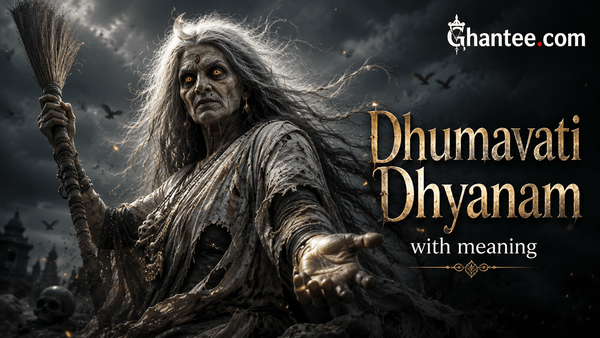
The Dhumavati Dhyanam is a Sanskrit meditation verse dedicated to Goddess Dhumavati — one of the ten Mahavidyas, revered as the widowed, smoke-formed goddess who embodies inauspiciousness, emptiness, and the wisdom hidden within loss. Unlike the youthful splendor of other Devi forms, Dhumavati appears aged, unadorned, and forsaken — a stark reminder that the Divine Mother pervades even what the world rejects as ill-omened. This dhyan (visualization) verse helps the devotee picture her stark, unsettling form and meditate on her as the power that dwells beyond desire, comfort, and illusion.
In this post, you’ll find:
The line-by-line meaning (in English)
The deeper spiritual symbolism
🔱 Dhumavati Dhyan Mantra
विवर्णा चञ्चला दुष्टा दीर्घा च मलिनाम्बरा ।
विमुक्तकुन्तला रूक्षा विधवा विरलद्विजा ॥ १॥
काकध्वजरथारूढा विलम्बितपयोधरा ।
शूर्पहस्तातिरूक्षाक्षा धूतहस्ता वरान्विता ॥ २॥
प्रवृद्धघोणा तु भृशं कुटिला कुटिलेक्षणा ।
क्षुत्पिपासार्दि ता ध्येया भयदा कलहास्पदा ॥ ३॥
अत्युच्चा मलिनाम्बराऽखिलजनोद्वेगावहा दुर्मना
रूक्षाक्षित्रितया विशालदशना सूर्योदरी चञ्चला ।
प्रस्वेदाम्बुचिता क्षुधाकुलतनुः कृष्णाऽतिरूक्षप्रभा
ध्येया मुक्तकचा सदाप्रियकलिर्धूमावती मन्त्रिणा ॥ ४॥
इति श्रीधूमावती ध्यानम् ॥
🧘♀️ Line-by-Line Meaning (Simple & Clear)
Verse 1
विवर्णा चञ्चला दुष्टा
She is pale and colorless in complexion, restless/unsteady, and fierce in nature.
दीर्घा च मलिनाम्बरा
She is tall in form, clothed in soiled, unwashed garments.
विमुक्तकुन्तला रूक्षा
Her hair hangs loose and disheveled, dry and rough.
विधवा विरलद्विजा
She appears as a widow, her teeth are sparse and scattered.
Verse 2
काकध्वजरथारूढा
She rides upon a chariot bearing the emblem of a crow.
विलम्बितपयोधरा
Her breasts hang long and loose.
शूर्पहस्तातिरूक्षाक्षा
In her hand she holds a winnowing basket (surpa), and her eyes are harsh and dry.
धूतहस्ता वरान्विता
Her hands tremble/shake, yet she still bestows boons.
Verse 3
प्रवृद्धघोणा तु भृशं
Her nose is prominently large.
कुटिला कुटिलेक्षणा
She is crooked in form, with a crooked, sidelong gaze.
क्षुत्पिपासार्दि ता ध्येया
She should be meditated upon as one afflicted by hunger and thirst.
भयदा कलहास्पदा
She is fear-inducing, and the very seat/source of conflict and strife.
Verse 4
अत्युच्चा मलिनाम्बराऽखिलजनोद्वेगावहा दुर्मना
She is extremely tall, dressed in soiled garments, causing unease in all who behold her, and appears ill-tempered.
रूक्षाक्षित्रितया विशालदशना सूर्योदरी चञ्चला
Her three eyes are dry and harsh, her teeth are large, her belly is gaunt/sun-scorched, and she is restless.
प्रस्वेदाम्बुचिता क्षुधाकुलतनुः कृष्णाऽतिरूक्षप्रभा
Her body is covered in sweat, wracked with hunger, dark in hue, with a harsh, rough radiance.
ध्येया मुक्तकचा सदाप्रियकलिर्धूमावती मन्त्रिणा
She should be meditated upon with her hair unbound — Dhumavati, who is ever fond of strife, worshipped by those who chant her mantra.
🔥 Deeper Spiritual Meaning
Every image in this dhyanam strips away comfort and beauty, pointing toward what lies beyond desire itself:
Widow form → Freedom from attachment, beyond the pairs of union and loss
Soiled, unwashed garments → Rejection of vanity and external adornment
Crow emblem and chariot → Association with omens, endings, and the discarded
Winnowing basket (Surpa) → Separation of the essential from the worthless, truth from illusion
Hunger and thirst → The unfulfillable nature of worldly craving
Trembling hands that still bless → Grace persists even in states of deprivation
Harsh, aged appearance → The dissolution of youth, beauty, and all impermanent forms
Seat of conflict (kalahaspada) → Confronting discord directly rather than avoiding it
Dhumavati teaches the wisdom of the inauspicious — that the Divine Mother is present not only in beauty and abundance, but equally in hunger, loss, old age, and what society casts aside. She is the emptiness that remains when all illusion has burned away, revealing a deeper, unconditioned peace.
✨ Final Thought
Where Tripura Bhairavi liberates through radiant, fearless clarity, Dhumavati liberates through stark, unsettling emptiness.
Meditate on her not seeking comfort, but seeking truth beyond comfort altogether.
She is what remains when everything inessential has been let go.

Add comment