
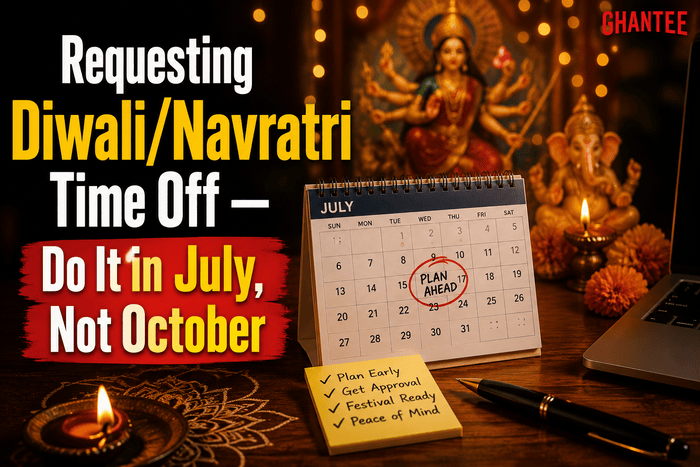
Every year it’s the same story. Diwali or Navratri rolls around in October, and somewhere in a group chat, someone asks: “did you get the day off?” Half the replies are a panicked “wait, I forgot to ask.” If that’s ever been you, this post is for you — and it’s landing in your inbox in July on purpose, not October, because by October it’s usually too late to ask for the good days.
Most Western workplaces don’t run on a calendar that knows Diwali exists. There’s no automatic reminder, no HR email, no company-wide heads-up. If you want the actual festival day off — not just a rushed evening after work — you have to ask. And the earlier you ask, the more likely you get a yes.
Why July, Specifically
Most companies open PTO calendars for Q4 sometime between July and September, and popular dates — especially around holidays — fill up fast. If you wait until September or October to ask, you’re competing with everyone else who’s already booked time around Thanksgiving, school breaks, or year-end vacations. By then, your manager may genuinely want to say yes and simply not be able to, because the team’s already short-staffed that week.
Asking in July isn’t about being extra organized for its own sake. It’s about being first in line before the calendar fills up around you.
Know Your Dates Before You Ask
Nothing undercuts a time-off request faster than having to go back a second time because you got the date wrong. Sharad Navratri begins October 11, 2026, Dussehra falls on October 20, and Diwali (Lakshmi Puja) is November 8. If you also observe Karva Chauth, Bhai Dooj, or Chhath Puja, those fall in the same general window — worth checking all of them before you request, so you only have to ask once. Our full 2026 Hindu festival calendar has the complete list if you want to double-check anything else on the calendar while you’re at it.
One honest note: this year has an Adhik Maas (extra lunar month), which pushed several festival dates later than usual. If you’re working off an old mental calendar from a couple of years ago, double-check — the dates have shifted more than a typical year.
How to Actually Ask
You don’t need a long explanation or a cultural history lesson in your request — just clarity and enough notice. A short, direct message works better than an over-justified one. Here’s a template you can adapt:
Hi [Manager’s name],
I wanted to get ahead of my Q4 time-off requests early. Diwali, one of the most important festivals in my culture, falls on November 8 this year, and I’d like to take that day off to observe it with my family. I’m also hoping to take [date] for Navratri/Dussehra if that works schedule-wise.
Happy to make sure my work is covered ahead of time — just wanted to flag it now while the calendar’s still open. Let me know if there’s anything you need from me to plan around it.
Thanks,
[Your name]
Notice what this template does: it names the festival plainly, gives the exact date, asks early, and offers to help with coverage before anyone has to ask. That last part matters more than people expect — managers say yes faster to requests that already sound thought-through.
If Your Workplace Doesn’t Know What Diwali Is
Plenty of workplaces, especially outside major metro areas, genuinely have no context for what you’re asking about. That’s alright — you don’t need them to understand the religious significance to grant the request, the same way they don’t need to understand the theology behind Christmas to give everyone that day off. A single sentence like “it’s one of the most significant festivals in Hinduism, similar in importance to Christmas or Eid” usually does the job without turning your PTO request into an explainer session.
If you do want to say more — some people like sharing a little context with their team, especially if colleagues ask — a short, warm note goes a long way. You don’t owe anyone a full explanation, but offering one is a nice way to make the day feel visible rather than just an entry in a leave tracker.
A Few Practical Things to Sort Out Alongside the Request
- Check if your company has floating holidays or a “cultural observance” policy separate from standard PTO — some do, and it doesn’t eat into your regular vacation days if you ask correctly.
- If you’re taking multiple days across the festival season, space out your requests rather than sending them all in one email — it’s easier for a manager to say yes to smaller asks spread over weeks than one big block all at once.
- If a full day off genuinely isn’t possible this year, ask about a half-day or a flexible start/end time instead — most managers can accommodate that even when a full day is a hard no.
One Last Thing
Asking for the day off is a small, practical thing. But it’s also a quiet way of saying that your festival, your family, and your practice matter enough to plan around — not just squeeze in after work if there’s time. That’s worth doing properly, and worth doing now, while the calendar’s still open.
Once the day’s actually secured, you can turn your attention to the fun part — our Dhyanam and mantra guides are a good place to start if you want to go a little deeper into the festival itself before it arrives.








Add comment