Vishnu Iconography Game
Learn the four divine weapons of Lord Vishnu — right in your browser
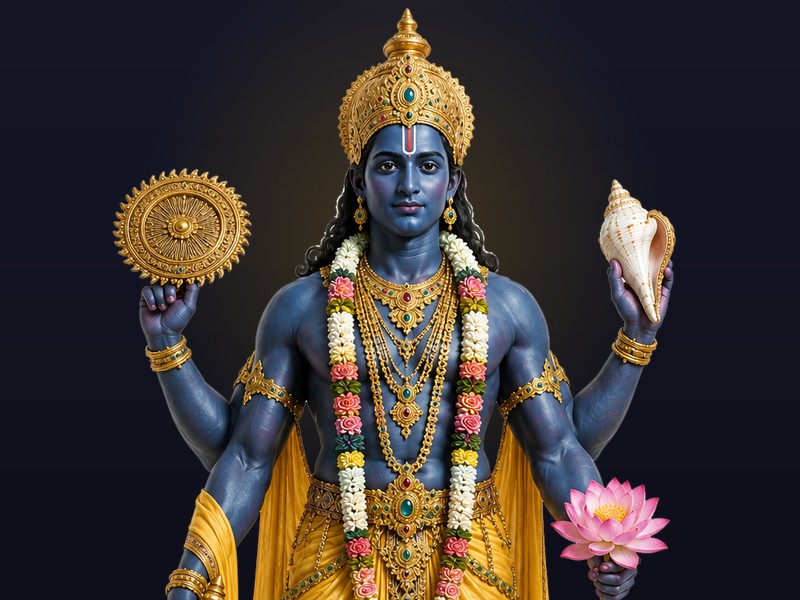
Every murti of Vishnu carries four sacred objects, each with its own story. The Sudarshan Chakra guards dharma. The Panchajanya shankha announces creation’s first sound. The Kaumodaki gada delivers justice. The padma stands for purity. Most of us recognise these objects without knowing what they mean.
This free game turns that gap into play: drag each weapon into the right hand from a set of eight — four real, four decoys — and watch Vishnu ji come alive once all four are correct. No download, no signup, works on phone and desktop.
The Four Ayudhas of Vishnu
In classical iconography, Vishnu is shown with four arms, each holding an object — collectively called his ayudhas. These aren’t just decorative; each one carries centuries of symbolic meaning.
Sudarshan Chakra (सुदर्शन चक्र)
The discus is Vishnu’s most recognisable weapon — a spinning wheel with serrated edges, usually shown in his upper hand. It represents the mind and the cycle of time, and its role is protective: it exists to defend dharma and cut down whatever threatens it. In many depictions, the Chakra is described as self-aware, returning to Vishnu’s hand after each strike.
Panchajanya Shankha (पाञ्चजन्य शंख)
The conch shell is held in one of the upper hands and is said to produce the sound “Om” — the first vibration of creation. Its blowing announces victory and the start of something auspicious; it’s the sound used to signal that dharma will prevail.
Kaumodaki Gada (कौमोदकी गदा)
The mace represents physical and mental strength directed toward justice. It’s the weapon Vishnu uses not to conquer but to discipline — a reminder that power exists to correct, not to dominate.
Padma (पद्म)
The lotus, held in a lower hand, stands apart from the other three: it’s not a weapon but a symbol. Growing untouched out of muddy water, it represents purity of being even while remaining part of the material world — a central idea in Vaishnavite philosophy.
Together, these four objects tell a complete story: Vishnu preserves order (chakra), announces truth (shankha), enforces justice (gada), and remains untouched by the world he sustains (padma).
Frequently Asked Questions
What will I learn from this game?
You'll learn to recognise Vishnu's four ayudhas — the Sudarshan Chakra, Panchajanya Shankha, Kaumodaki Gada, and Padma — and what each one represents in Hindu iconography.
Is this game free to play?
Yes, completely free — no signup, no download, no in-app purchases.
What age group is this game designed for?
It's built for children aged 5–15, though the iconographic detail is accurate enough that adults enjoy it too.
Are the four weapons scripturally accurate?
Yes — the iconography follows classical sources such as Gopinatha Rao's "Elements of Hindu Iconography" and related texts, the same references used across House of Ghantee's videos and artwork.
Do I need to download anything to play?
No. It runs directly in your browser on any phone, tablet, or computer.
