🔱 Tara Dhyan Mantra (Original)
प्रत्यालीढपदां घोरां मुण्डमालाविभूषिताम् ।
खर्व्वां लम्बोदरीं भीमां व्याघ्रचर्म्मावृत्तां कटौ ॥
नवयौवनसम्पन्नां पञ्चमुद्राविभूषिताम् ।
चतुर्भूजां लोलजिह्वां महाभीमा वरप्रदाम् ॥
खंगकर्तृसमायुक्तसव्येतरभुजद्वयाम् ।
कपोलोत्पलसंयुक्तसव्यपाणियुगान्विताम् ॥
पिंगाग्रैकजटां ध्यायेन्मौलावक्षोभ्यभूषिताम् ।
बालार्कमण्डलाकारलोचनत्रय भूषिताम् ॥
ज्वलच्चितामध्यगतां घोरदंष्ट्राकरालिनीम् ।
स्वादेशस्मेरवदनां ह्यलंकारविभूषिताम् ॥
विश्वव्यापकतोयान्तः श्वेतपद्मोपरिं स्थिताम् ॥
(Traditional Tara Dhyana from Tantric texts – meditation on the Ugra (fierce) form of Tara)
🧘♂️ Line-by-Line Meaning (Simple & Clear)
प्रत्यालीढपदां
She stands in the pratyālīḍha posture (a warrior’s stance, right leg bent forward, left leg stretched back – ready for battle).
घोरां
She is terrifying in appearance.
मुण्डमालाविभूषिताम्
She is adorned with a garland of severed heads.
खर्व्वां लम्बोदरीं भीमां
She is dwarfish (kharba) in stature, with a hanging belly, and fearsome (bhima).
व्याघ्रचर्म्मावृत्तां कटौ
She wears a tiger skin around her waist.
नवयौवनसम्पन्नां
She is in the prime of eternal youth.
पञ्चमुद्राविभूषिताम्
She is adorned with the five tantric mudras (ornaments of a hero – bone ornaments, etc.).
चतुर्भूजां
She has four arms.
लोलजिह्वां
Her tongue is lolling out (restless, ready to lap up blood or sound).
महाभीमा वरप्रदाम्
She is greatly terrifying, yet she grants boons (varada).
खंगकर्तृसमायुक्तसव्येतरभुजद्वयाम्
Her left and right hands hold a sword (khanga) and a cleaver (kartri).
कपोलोत्पलसंयुक्तसव्यपाणियुगान्विताम्
Her right hand(s) hold a blue lotus (utpala) and a pair of scissors or shears (kapola – some traditions).
पिंगाग्रैकजटां
She has a single matted lock of hair (jata) that is tawny (pinga) at the tip.
ध्यायेन्मौलावक्षोभ्यभूषिताम्
On her crown she wears the Akshobhya (one of the five Dhyani Buddhas) as an ornament.
बालार्कमण्डलाकारलोचनत्रय भूषिताम्
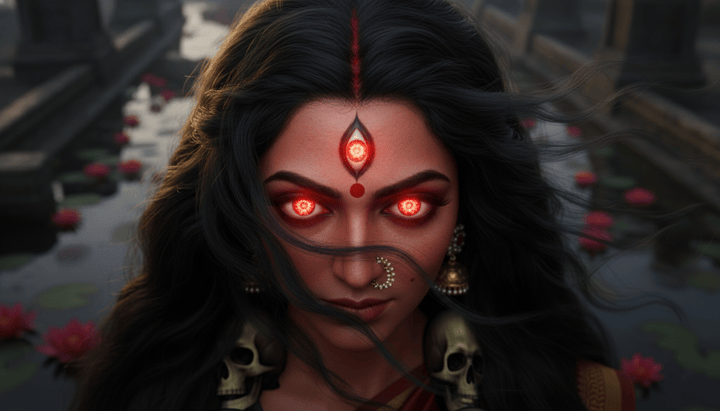
Her three eyes are like rising suns (balarka mandala – young sun disc).
ज्वलच्चितामध्यगतां
She dwells in the midst of a blazing cremation ground.
घोरदंष्ट्राकरालिनीम्
She has terrible fangs and a terrifying face.
स्वादेशस्मेरवदनां
Her face shows a slight smile (of blessing and destruction).
ह्यलंकारविभूषिताम्
She is fully adorned with ornaments.
विश्वव्यापकतोयान्तः श्वेतपद्मोपरिं स्थिताम्
She is seated upon a white lotus within the all-pervading cosmic waters.
🎶 Deeper Spiritual Meaning
Tara is the second Mahavidya, often called Neela Saraswati or the fierce form of compassion. While the Buddhist Tara is peaceful, the Hindu Tantric Tara is wrathful—yet both save. This dhyanam describes her Ugra Tara (fierce) form.
🔹 Key Symbolism
- Warrior stance (pratyālīḍha) → Ready to destroy evil and protect devotees instantly
- Garland of heads → Conquest of ego, desires, and past lives
- Tiger skin waist → Mastery over raw energy and fearlessness
- Hanging belly (lambodari) → She consumes all existence; also a sign of yogic power (siddhi)
- Four arms → Complete control over the four directions or four aspects of existence
- Lolling tongue → Insatiable consumption of negativity; also the sound of mantra (as she is the goddess of speech)
- Sword and cleaver → Cutting through ignorance and ego
- Blue lotus → Wisdom that arises from darkness (like a lotus from mud)
- Tawny matted hair → Fiery, untamed ascetic power
- Akshobhya on crown → Connection to the unshakeable Buddha nature – compassion in wrath
- Three eyes like rising suns → All-seeing, burning away ignorance, illuminating past/present/future
- Blazing cremation ground → She rules over death and transformation
- White lotus on cosmic waters → Purity and creation arising from the void
Tara represents compassion in action – swift, fierce, and unstoppable. She does not hesitate. When a devotee calls, she runs to save, even destroying the laws of karma if needed.
Meditating on Tara is especially powerful for:
- Protection from sudden danger or accidents
- Overcoming fear of death
- Breaking through speech impediments or gaining eloquent speech
- Crossing difficult life transitions (like crossing a river or ocean)
- Awakening kundalini quickly (she is also a form of kundalini shakti)
✨ Final Thought
Tara is the mother who does not wait –
She runs toward your pain before you finish crying.
She teaches:
- Compassion is not always gentle; sometimes it is a sword
- Fear dissolves when you know someone is already saving you
- Your voice, when infused with her mantra, becomes her power
Meditate on her to unlock:
- Swift protection
- Fearlessness in crisis
- Mastery over sound and speech
She is the star that guides you through the darkest ocean – and the storm itself.


 12Apr
12Apr  by
by